Current Water Restrictions
Phase II Water Shortage Irrigation Restrictions in Effect
Effective February 8, 2026 - July 1, 2026
Due to dry conditions and lower-than-average water levels, the Southwest Florida Water Management District (SWFWMD) has declared a Phase II Water Shortage. As required by Florida Rule 40D-22.201 and City of Lakeland Ordinance 4844, the City of Lakeland has implemented more restrictive irrigation limits to help protect our water supply.

This temporary schedule replaces the City's year-round irrigation schedule while Phase II Water Shortage restrictions are in effect.
What This Means for You:
- Outdoor irrigation is more limited than the year-round schedule
- Most properties may irrigate only 1 day per week, no matter if water source is City or private well
- Hand watering and microirrigation are still allowed at any time when used efficiently
- Wasteful water use is prohibited at all times
Phase II Irrigation Schedule (Currently in Effect):
Lawn and Landscape Watering Times
Applies to turf (grass or sod) and landscape plants.
- Properties under 2 acres in size- Before 8 a.m. or After 6 p.m., but not both
- Properties greater than 2 acres in size- Before 10 a.m. or After 4 p.m., but not both
These restrictions apply to all water sources and high-volume irrigation systems, including in-ground systems and portable sprinklers.
Watering Days by Address Number
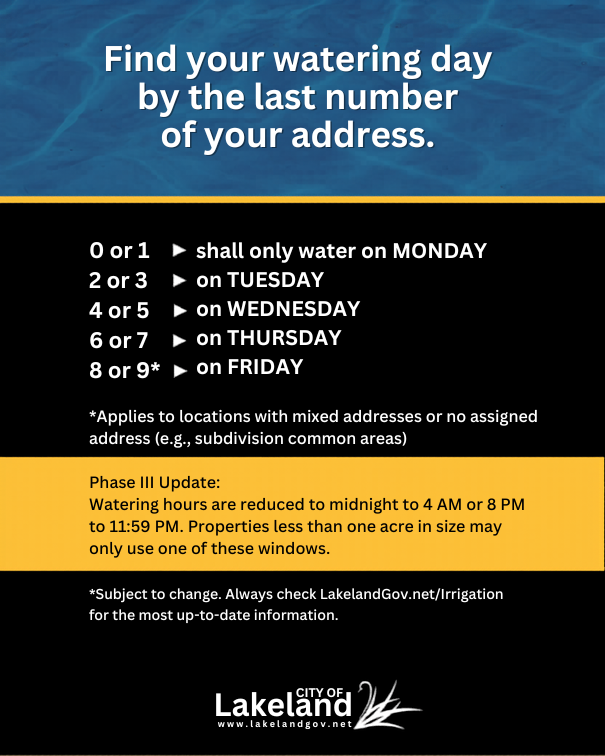
Water is limited to one day per week, based on the last digit of the address:
0 or 1: Monday
2 or 3: Tuesday
4 or 5: Wednesday
6 or 7: Thursday
8 or 9: Friday
Example: 123 Save Water Street would only water on Tuesday
*Properties without a discernible address, such as neighborhood entryways and common areas, may water on Friday only.
Special Landscape Uses
Golf courses, athletic fields, cemeteries, and other non-residential landscape uses may have different requirements. These locations are subject to the Phase II landscape restrictions under Florida Rule 40D-21.631.
If a property holds a Water Use Permit, all permit conditions must be met. Owners and managers of these properties should refer to Florida Rule 40D-21.631 and applicable permit documents for specific requirements.
Please note: Water shortage phases are evaluated regularly, and restrictions may change before July 1, 2026.
Rules to Follow:
- The one-day-a-week schedule above must be followed during the water shortage declaration. The year-round schedule resumes when water levels return to normal, and SWFWMD rescinds the water shortage order.
- Watering times are dependent on property size. Properties less than 2 acres in size are allowed to irrigate before 8 a.m. or after 6 p.m. (but not both). Properties greater than 2 acres in size are allowed to water before 10 a.m. or after 4 p.m. (but not both).
- All automatic irrigation systems are required to have a working rain shut off device.
- Variances are available, through the Southwest Florida Water Management District, if a property proposes an alternate irrigation plan (such as splitting a large property into two pieces and assigning a different day to each piece). Download an Application
- Hand watering (with automatic shut-off device) or micro-irrigation of non-lawn landscaping is not currently restricted by day or times.
- These restrictions apply to private residences and to commercial landscapes.
Newly Planted Lawns & Landscapes:
Newly planted turf and landscape plants may be watered more frequently for a limited establishment period, even during a Phase II Water Shortage, provided watering is done efficiently and without waste.
Establishment Periods
- New lawns and plants have a 60-day establishment period. (In the case we receive a report of you irrigating outside of the allowed schedule, keep a receipt for proof of new material installation. Before and after pictures are also helpful).
- Guidelines (only applies to new plant installations- after 60 days you must return to the irrigation schedule stated above):
- Days 1 through 30: May water on any day before 8 a.m. or after 6 p.m. (but not both)
- Days 31 through 60: May water on the following days before 8 a.m. or after 6 p.m. (but not both):
- Even Addresses Ending in 0, 2, 4, 6, or 8 may water Tuesday, Thursday, and/or Sunday
- Odd Addresses Ending in 1, 3, 5, 7, or 9 may water Monday, Wednesday, and/or Saturday
- All locations without a discernible address (such as common areas and subdivision entry ways) may water on Tuesday, Friday, and/or Sunday
- This establishment period begins the day the New Plant Materials is installed and is limited to areas containing New Plant Material only. An entire zone of an irrigation system may only be used for establishment period watering if the zone in question is for an area that contains a minimum of 50% New Plant Material.
- The property owner or manager shall, upon request, provide a receipt or other proof of qualification for the new plant establishment period or other claimed exemption or allowance.
To Report Irrigation Concerns Within City Limits:
Please utilize the Citizens Action Center Reporting system. Make sure to include the location address, date, and time of the incident.
For Additional Information:
On January 27, 2026, a Phase II Water Shortage per Rule 40D-21 was declared by the Governing Board of the Southwest Florida Water Management District. Florida received below average rainfall during the summer rainy season and, as of December, has a 13-inch rainfall deficit compared to the historical average 12-month total. Water levels in the region's aquifers, rivers, and lakes are declining. Public water supplies in the Tampa Bay area are lower than expected at this time of year.
This is only a summary. All water users should review Water Shortage Rules outlined in Rule 40D-22 of the Southwest Florida Water Management District.
The Southwest Florida Water Management District has a toll-free line (800-848-0499) to provide answers to questions about water restrictions.
Information on water conservation is also available on the Southwest Florida Water Management District Website.

All Other Water Uses:
-
Car & Truck Washing
Washing a car at home (non-commercial) is only allowed on your lawn watering day and should be done on the lawn to reduce runoff.
Using an automatic shut-off nozzle on a hose is required.
-
Fertilizer & Pesticide Applications
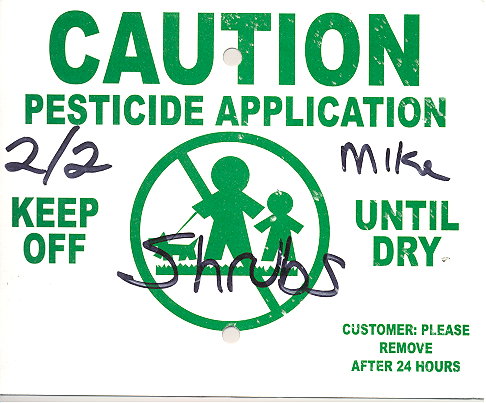
Watering pesticides and fertilizers into grass as required by the manufacturer of the product is allowed on any day. However, signs must be posted on the lawn, and the date of the application must be written clearly on the sign (See sample below). These applications are not restricted to the appointed irrigation day, but it is recommended to plan applications around your irrigation schedule (not rain events).

According to Green-Industry Best Management Practices, do not apply fertilizers or pesticides prior to a large rain event. While it is recommended these applications be watered into the landscape, only a quarter of an inch of water is necessary. Any more than that and most of the product will leach too far into the soil, becoming unavailable for plant use. This practice will also cut down on the amount of pesticide and fertilizer that gets washed away in storm water runoff. By following the manufacturer label directions on any product applied to your lawn and landscape, you can help minimize pollution and give your plants the best possible growing conditions.
Do not fertilize dormant or non-growing turfgrass, usually seen during winter months.
Fertilizer Best Management Practices for Turfgrass and Landscape
- Do not fertilize if a heavy rainfall is expected, especially tropical or frontal weather systems.
- Match the product to the situation. After ruling out other issues such as too much shade, overwatering, or other stresses that may be affecting your plants, do a soil test to verify fertilizing is the correct response. This will also help determine what kind of product you need.
- Read the label thoroughly!
- Know your yard. Measure the square footage of the area you need to fertilize, follow the label directions for application amount and make sure your spreader/equipment is properly cleaned and calibrated. Remember that more does not always mean better.
- Irrigate 1/4 inch following fertilization to avoid the loss of nitrogen and increase uptake efficiency. Without proper irrigation, you risk volatilization (the loss of applied nitrogen to the atmosphere as ammonia gas) and inefficient use of fertilizer.
- Ensure fertilizer is not left around impervious areas such as streets, driveways, or sidewalks. These areas allow the fertilizer to runoff into storm drains and bodies of water.
- Always leave a Ring of Responsibility, a preventative buffer that protects against accidental direct contamination of bodies of water. With liquid fertilizers this is at least 3 feet from the edge of the water. Granular fertilizers need to be kept 10 feet from shorelines. Deflector shields can be used when broadcasting.
Pesticide Best Management Practices for Turfgrass and Landscape
- Always observe label directions, restrictions, and precautions. It is dangerous, wasteful, and illegal to do otherwise.
- Store pesticides behind locked doors in original containers with labels intact, separate from seed and fertilizer.
- Use pesticides at the correct application rate and recommended intervals between applications.
- Never eat, drink, or smoke when handling pesticides, and always wash with soap and water after use.
- Triple-rinse containers into the spray tank. Never pour pesticides down the drain or into an area exposed to humans, animals, or water.
- Dispose of used containers in compliance with label directions so that water contamination and other hazards will not result.
- Always wear protective clothing when applying pesticides. At a minimum, wear a long-sleeved shirt, long-legged pants, rubber gloves, boots (never go barefoot or wear sandals), eye protection, and a wide-brimmed hat. Additional protective gear may be listed on the pesticide label.
-
Fountains & Falls
Aesthetic fountain use is limited to eight hours a day. For exemptions for Koi ponds, small fountains, interactive commercial/institutional recreation areas, and other incidental uses, please refer to F.A.C. 40D-21.631.
-
Pressure Washing
Annual pressure washing or in preparation for painting and sealing is allowed.
Pressure washing driveways, sidewalks, and other impervious surfaces is allowed for necessary maintenance, such as to either maintain a warranty or remove mold, mildew and other potentially hazardous material that cannot be removed by mechanical means (such as a broom or leaf blower) and as a construction practice (such as cleaning a concrete surface prior to painting or sealing). Compliance with homeowner association or other aesthetic standards does not constitute necessary maintenance.
-
Sprinkler (Irrigation) System Maintenance
Sprinkler systems may be run a maximum of ten minutes per zone to perform maintenance on the system. Each zone must be attended through the entire run time. Sprinkler maintenance is not restricted to the appointed irrigation days. Sprinkler maintenance should be conducted as efficiently as possible to adhere to the general restriction prohibiting wasteful water use.
-
Penalties for Violations
Violations of these restrictions are a civil infraction punishable with fines up to $500:
- First Violation: Written Warning
- Second Violation: $35 Fine
- Third Violation: $75 Fine
- Fourth or More: Mandatory Court Appearance and up to $500 fine + court costs
Report a Possible Violation
Please call City of Lakeland Water Utilities at (863) 834-6193 or click here to report now.
All reports must include date(s), time(s), and the nature of the possible violation(s).